
Table of Contents
- Understanding Sliding Door Handle Types
- How to Measure Your Sliding Door Handle
- Mortise vs Surface Mount Handles Explained
- Sliding Door Lock Types & Security Features
- Top 10 Sliding Door Handle Alternatives
- 1. Prime-Line Sliding Patio Door Handle Set – Budget-Friendly Reliability
- 2. Hoppe HLS®9000 Series – Premium Heavy-Duty Performance
- 3. FPL Embassy Series – Luxury Brass Construction
- 4. Rockwell Security Sliding Door Handles – Commercial-Grade Durability
- 5. Coastal Group BLU™ – Marine-Grade Corrosion Resistance
- 6. JNF Architectural Hardware – Modern Minimalist Design
- 7. M&T Sliding Door Pull Handles – European Design Focus
- 8. Emtek Sliding Door Hardware – Customisable Finishes
- 9. FSB Sliding Door Handles – German Ergonomic Engineering
- 10. Slide Master Hardware – Expert Australian Support
- Residential vs Commercial Sliding Door Hardware
- Handle Finish & Colour Options for Your Space
- Installation Guide for Sliding Door Handle Replacement
Sliding Door Handle: 10 Options & Selection Guide
Last Updated: July 3, 2026
When your sliding glass patio door handle breaks or becomes difficult to operate, finding the right replacement requires understanding specifications and compatibility. A sliding door handle is a security feature, aesthetic choice, and daily touchpoint that affects how smoothly your door operates. This guide walks you through essential measurements, handle types, and top alternatives available in the Australian market.
Understanding Sliding Door Handle Types
Different sliding door systems require different handle styles. Mortise style handles integrate a locking mechanism directly into the handle assembly, while flush mount pulls rely on separate locking hardware mounted elsewhere on the door frame.
Mortise Style Handles
A mortise style handle incorporates a locking mechanism housed within the handle itself, requiring a rectangular cavity (mortise) cut into the door edge. This design is most common for residential patio doors and provides secure, integrated locking without additional external hardware.
Mortise handles feature an interior handle with a thumb turn or lever mechanism and an exterior handle that may be keyed or non-keyed. The latch bolt extends from the door edge into the frame, creating the locking point.
The critical measurement for mortise handles is the backset, the distance from the door edge to the centre of the hole where the latch bolt exits. Mortise handles typically have backsets of 45mm, 50mm, or 55mm. Measure this carefully before ordering, as incorrect backset means the latch won’t align with the strike plate.
Flush Mount Door Pulls
A flush mount door pull sits flush against the door surface without protruding significantly, paired with a separate surface-mounted locking mechanism on the door frame or stile. This style is common on commercial sliding doors and modern residential installations prioritising minimalist aesthetics.
Flush mount pulls don’t incorporate the locking mechanism themselves. Instead, the lock is housed separately, usually at mid-height on the door frame. Flush mount systems offer sleek lines and are easier to retrofit into doors where cutting a mortise cavity isn’t feasible.
How to Measure Your Sliding Door Handle
Accurate measurements are essential when ordering a replacement. A single millimetre error in hole spacing or backset can result in a handle that won’t fit or a latch that misaligns with the strike plate.
Measuring Hole Spacing and Backset
The hole spacing (also called "centres") is the distance between the two mounting holes on your existing handle. Most residential sliding door handles use 45mm, 50mm, 55mm, or 60mm hole spacing. Remove your existing handle if possible and measure centre-to-centre with a ruler or calliper.
The backset is the distance from the door’s edge to the centre of the latch bolt hole (for mortise handles) or the centre of the main mounting hole. For mortise handles, backset is typically 45mm, 50mm, or 55mm. This measurement is critical because incorrect backset means the latch won’t align with the strike plate.
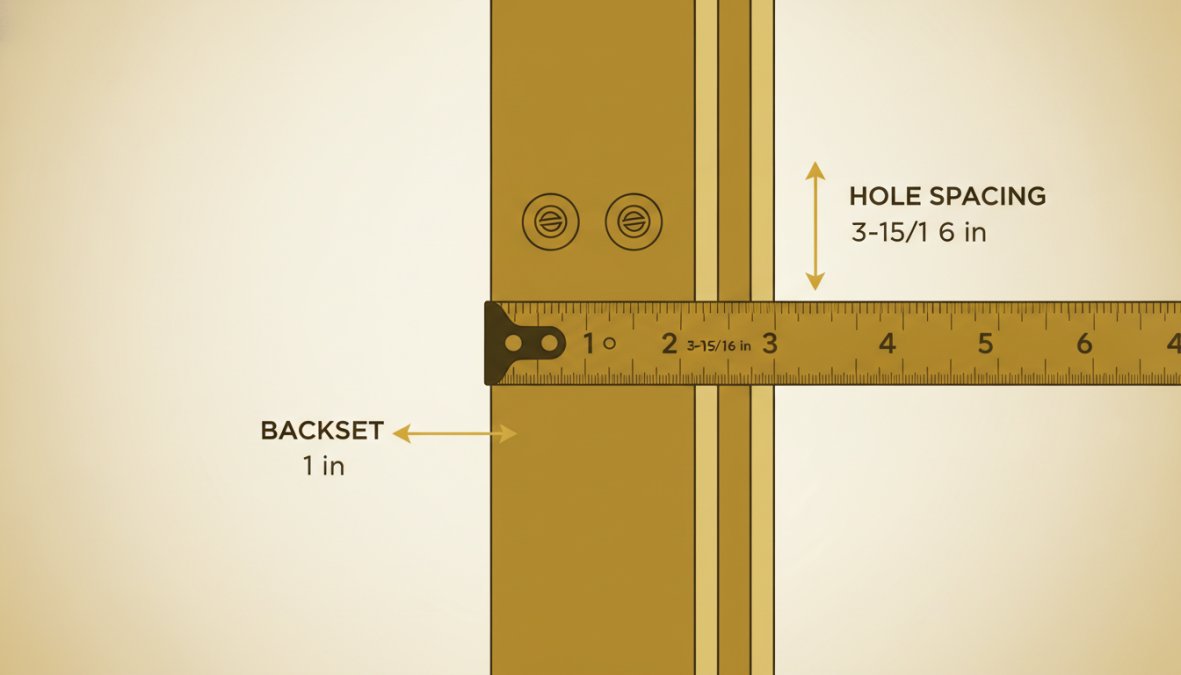
Document measurements in writing and photograph your existing handle from multiple angles for reference when communicating with suppliers.
Checking Door Thickness Compatibility
Most residential sliding glass patio doors are 35mm, 40mm, or 45mm thick. Thicker commercial doors may measure 50mm or more. Check door thickness by measuring the edge of the glass where it meets the frame. Some handles have adjustable mounting holes with washers that accommodate a range of thicknesses, while others are designed for specific thickness only.
Installing a handle designed for thinner doors on a thicker door can result in mounting bolts not reaching far enough to secure properly, creating a loose handle that won’t lock.
Mortise vs Surface Mount Handles Explained
Mortise handles integrate the locking mechanism into the handle assembly, requiring a rectangular cavity cut into the door edge. This concentrates mechanical components in one place, making the system strong and simple. Because everything is contained within the door’s edge, mortise handles are less exposed to weather and corrosion.
Surface mount (flush mount) handles keep the pull separate from the locking mechanism, with the lock mounted on the door frame or stile. This configuration allows cleaner visual appearance and greater design flexibility. However, surface mount systems introduce more moving parts and more exposure to the elements.
From an installation perspective, mortise handles require precise cutting if replacing a handle in a door without a pre-existing mortise cavity. Surface mount systems are easier to retrofit because they don’t require cavity modification. Both systems can be equally effective when properly installed.
Sliding Door Lock Types & Security Features
The locking mechanism you choose directly impacts your home’s security and daily convenience.
Keyed Patio Door Handles
A keyed patio door handle incorporates a key lock directly into the handle assembly, allowing you to lock the door from the outside without relying on an interior thumb turn. This design is essential for exterior doors where you want to prevent unauthorised access.
Keyed handles feature a cylinder lock on the exterior side that accepts a standard key, while the interior side has a thumb turn lever allowing quick locking from inside without needing a key. Security level depends on the quality of the cylinder lock and strength of the latch bolt. For Perth homes, corrosion resistance is equally important, look for handles with stainless steel components or PVD (Physical Vapour Deposition) coatings.
Keyed handles work best for ground-floor patio doors, doors accessible from outdoor areas, or any sliding door you want to secure against unauthorised external access.
Thumb Turn & Non-Keyed Options
A thumb turn handle uses a lever or rotating mechanism on the interior side to lock and unlock the door, with no key required. The exterior side typically has a fixed pull with no lock mechanism. This design is common on interior sliding doors, upper-floor balcony doors, or situations where you want to prevent accidental opening without high security.
Thumb turn handles are faster to operate but offer less security against determined intrusion. Non-keyed handles with fixed pulls provide zero security and are used on interior doors where locking isn’t required.
Top 10 Sliding Door Handle Alternatives
The following options represent the most popular and reliable sliding door handles available in the Australian market.
1. Prime-Line Sliding Patio Door Handle Set – Budget-Friendly Reliability
Prime-Line is an established American manufacturer known for producing affordable, durable replacement hardware. Their standard sliding patio door handle set is one of the most commonly purchased options in Australia because it offers solid functionality at an accessible price point.
The Prime-Line handle set features a mortise-style locking mechanism with both interior thumb turn and exterior pull components. The set typically includes adjustable mounting holes that accommodate door thicknesses from 35mm to 45mm, making it compatible with most standard residential sliding glass patio doors. Finish options usually include white, black, and chrome.
Customers report that Prime-Line handles are straightforward to install with clear instructions and all necessary hardware included. Corrosion resistance is moderate, the handles hold up reasonably well in Perth’s climate but aren’t specifically engineered for coastal salt spray exposure.
Best for homeowners seeking a reliable, no-frills replacement that won’t break the budget.
2. Hoppe HLS®9000 Series – Premium Heavy-Duty Performance
Hoppe is a German manufacturer specialising in high-performance architectural hardware. The HLS®9000 series represents their premium sliding door handle line, engineered for heavy-duty use, smooth operation, and integration with multi-point locking systems.
The HLS®9000 handles are constructed from strong materials with precision engineering that ensures consistent, smooth operation even after thousands of cycles. They’re designed to integrate seamlessly with Hoppe’s multi-point locking systems, which lock the door at multiple points along the frame for superior security and weather sealing. Handles are available in many architectural finishes including satin stainless steel, powder-coated colours, and anodised aluminium.
Best for architects, builders, and homeowners undertaking premium renovations where hardware quality and aesthetic coordination are priorities.
3. FPL Embassy Series – Luxury Brass Construction
FPL Door Hardware manufactures luxury sliding door handles from solid brass, designed for high-end residential applications where hardware aesthetics are as important as function. The Embassy series combines heavy-duty security features with premium materials and finishes that develop character over time.
Solid brass construction gives these handles substantial weight and a luxurious feel. Brass naturally resists corrosion and develops a patina over time. The Embassy series is available in keyed and non-keyed configurations, with finishes including polished brass, satin brass, and oil-rubbed bronze.
Best for luxury home renovations, heritage properties, or any situation where the sliding door handle is a visible design element.
4. Rockwell Security Sliding Door Handles – Commercial-Grade Durability
Rockwell Security has manufactured sliding door hardware for over 30 years, building a reputation for durability and reliability in both residential and commercial settings. Their handles are engineered for high-traffic environments and are available in multiple design series.
Rockwell handles are constructed from hardened materials designed to withstand thousands of cycles without degradation. They’re compatible with dual-point locking systems, making them suitable for commercial applications where security and reliability are paramount.
Best for commercial installations, multi-unit residential buildings, or any application where durability and bulk availability are priorities.
5. Coastal Group BLU™ – Marine-Grade Corrosion Resistance
Coastal Group manufactures the BLU™ series specifically for properties in coastal and high-salt environments. These handles are fabricated from 316-grade marine stainless steel, making them among the most corrosion-resistant options available for Australian coastal homes.
The BLU™ handles feature a contemporary design with hidden fixings that create a clean, uninterrupted line along the door edge. The stainless steel construction means there’s no coating to chip or fade, corrosion resistance is built into the material itself.
Best for coastal properties, beachfront homes, or any location where salt spray exposure is a concern.
6. JNF Architectural Hardware – Modern Minimalist Design
JNF is a Portuguese manufacturer known for design-forward, minimalist architectural hardware using advanced materials and manufacturing techniques. Their sliding door handles reflect contemporary design sensibilities with clean lines, hidden fixings, and material choices like 316L stainless steel and PVD titanium coatings.
JNF handles are engineered using CNC precision manufacturing, resulting in handles with exceptionally tight tolerances and smooth operation. Availability in Australia is limited through specialist architectural suppliers, with extended lead times and premium pricing.
Best for contemporary residential projects, architectural installations, or situations where minimalist design is a core priority.
7. M&T Sliding Door Pull Handles – European Design Focus
M&T is a Czech manufacturer offering design-focused pull handles for sliding doors, including magnetic and locking variants. Their product range includes the Minimal series (ultra-minimalist), Maximal series (bold statement pieces), and Entero series (transitional designs).
M&T handles are fabricated from high-quality stainless steel with finishes including titanium black matt, polished stainless, and satin finishes. These handles are primarily available through European suppliers and specialist retailers in Australia, with lead times of 6-8 weeks.
Best for interior designers, architects specifying cohesive hardware across multiple doors, or homeowners wanting European design quality.
8. Emtek Sliding Door Hardware – Customisable Finishes
Emtek is a well-established American brand known for high-quality, customisable door hardware available in an extensive range of finishes and styles. Their sliding door handle collection includes options suitable for contemporary, traditional, and transitional design schemes.
Emtek handles are available in finishes including polished chrome, satin chrome, antique brass, oil-rubbed bronze, and numerous powder-coated colours. This finish range allows you to match existing hardware throughout your home. Availability in Australia is good through major hardware retailers and online suppliers.
Best for homeowners wanting to coordinate sliding door hardware with other door hardware throughout their home, or for situations where finish customisation is important.
9. FSB Sliding Door Handles – German Ergonomic Engineering
FSB is a German manufacturer renowned for ergonomic design and precision engineering applied to architectural hardware. Their sliding door handles reflect a philosophy of human-centred design, where every curve, angle, and grip is engineered to feel natural in the hand.
FSB handles feature minimalist aesthetics with exceptional attention to material quality and manufacturing precision. Handles are available in stainless steel, aluminium, and various finishes. The company’s focus on ergonomics makes these handles particularly suitable for homes where elderly residents, children, or people with limited hand strength need easy-to-operate door hardware.
Best for modern, minimalist homes; aging-in-place renovations; or situations where ergonomic design and German engineering quality are priorities.
10. Slide Master Hardware – Expert Australian Support
Slide Master Hardware specialises in identifying and supplying the exact sliding door handles and replacement parts needed to keep Australian homes and commercial properties functioning perfectly. Based in Perth, Slide Master Hardware serves customers across Australia with expert guidance via email and fast, reliable shipping.
The key differentiator is their expert identification service, you can submit photos of your existing handle or door, and their team will identify the exact replacement needed, eliminating the risk of ordering incompatible hardware. They stock parts for all major Australian sliding door brands and offer same-day dispatch for in-stock items ordered before 1pm AWST.
Best for Australian homeowners wanting expert identification before purchasing, fast turnaround times, and support from a company familiar with Australian door brands and climate conditions.
| Handle Option | Best For | Key Advantage | Installation Difficulty |
|---|---|---|---|
| Prime-Line | Budget-conscious homeowners | Affordable, widely compatible | Easy |
| Hoppe HLS®9000 | Premium renovations | Heavy-duty performance | Moderate |
| FPL Embassy | Luxury homes, design features | Solid brass aesthetics | Moderate |
| Rockwell Security | Commercial, high-traffic | Durability, bulk availability | Moderate |
| Coastal Group BLU™ | Coastal properties | Marine-grade corrosion resistance | Easy |
| JNF Architectural | Contemporary design focus | Minimalist aesthetics | Moderate |
| M&T European | Design coordination | Extensive finish range | Moderate |
| Emtek | Finish customisation | Wide colour/finish options | Easy |
| FSB German | Ergonomic priority | Smooth operation, comfort | Moderate |
| Slide Master Hardware | Australian homeowners | Expert identification, fast service | Easy |
Residential vs Commercial Sliding Door Hardware
Residential sliding door handles are engineered for typical home use, daily opening and closing, moderate traffic, and standard security requirements. They’re designed around 3,000-5,000 operating cycles per year. Materials and construction methods are optimised for cost-effectiveness while maintaining acceptable durability. Residential handles typically feature single-point locking mechanisms and are available in many finishes and styles.
Commercial sliding door hardware is engineered for high-traffic environments where doors may experience 20,000-50,000 cycles per year or more. Commercial handles are constructed from heavier materials, use stronger locking mechanisms (often multi-point systems), and are manufactured to tighter tolerances.
If you’re installing a sliding door in a commercial setting, retail space, office, or multi-unit residential building, specify commercial-grade hardware. Residential handles won’t withstand the usage demands and will require replacement within 2-3 years rather than 7-10 years.
Handle Finish & Colour Options for Your Space
The finish you choose affects both aesthetics and durability, particularly in Perth’s climate where humidity, salt spray, and UV exposure challenge hardware finishes.
Polished Chrome is a classic, bright finish that reflects light and creates a contemporary appearance. Chrome plating provides decent corrosion resistance for inland locations but can develop spotting in coastal areas.
Satin Chrome (also called brushed chrome) has a matte appearance that hides fingerprints better than polished chrome and requires less frequent cleaning.
Stainless Steel (typically 304-grade for standard applications, 316-grade for coastal) offers excellent corrosion resistance. Stainless steel doesn’t require coating, corrosion resistance is inherent to the material. Stainless steel is ideal for coastal properties and high-humidity areas.
Oil-Rubbed Bronze is a warm, traditional finish with an aged appearance that develops character over time. It suits traditional, transitional, and some contemporary design schemes.
Powder-Coated Finishes are available in virtually any colour, allowing specification of hardware that matches your door frame colour or complements your design scheme.
Brass develops a natural patina over time. Solid brass is inherently corrosion-resistant and improves with age.
For Perth homes, consider your location relative to the coast. Coastal properties benefit from stainless steel (particularly 316-grade) or solid brass. Inland properties can use chrome, powder-coated, or traditional finishes.
Installation Guide for Sliding Door Handle Replacement
Replacing a sliding door handle is a manageable DIY project for most homeowners, provided you have the correct measurements and compatible replacement hardware. The process typically takes 30-60 minutes and requires only basic hand tools.
Tools & Materials You’ll Need
- Tape measure
- Screwdriver set (Phillips and flathead, various sizes)
- Allen key set (hex keys, if your handle uses hex-socket bolts)
- Pliers
- Replacement handle set (verified to match your door’s specifications)
- Washers and spacers (if needed for door thickness adjustment)
- Lubricating spray (WD-40 or similar)
- Clean cloth
Step-by-Step Installation Process
Step 1: Remove the Existing Handle (10-15 minutes)
Locate the bolts securing your existing handle. For most mortise handles, you’ll find bolts on the interior side of the door. Remove these bolts using the appropriate screwdriver or Allen key. Once bolts are removed, gently pull the exterior handle away from the door. If it’s stuck, apply penetrating lubricant and wait 5-10 minutes before attempting removal again. Clean the door edge thoroughly with a cloth.
Step 2: Verify Hole Alignment and Door Thickness (5 minutes)
With the old handle removed, verify that the mounting holes in your door align with the holes in your new handle. Check that your door thickness falls within the new handle’s tolerance range.
Step 3: Install the New Exterior Handle (10-15 minutes)
Insert the exterior handle component through the door from outside. Ensure the latch bolt (for mortise handles) is oriented correctly, extending from the door edge toward the frame. Align the mounting holes carefully. Insert bolts through the exterior handle and through the door, ensuring they thread into the interior component. Tighten bolts gradually, alternating between bolts to ensure even pressure. Verify that the latch bolt moves smoothly when you operate the handle.
Step 4: Install the Interior Handle Component (5-10 minutes)
Insert the interior handle through the door from inside, aligning it with the exterior component. Thread bolts through the interior handle and tighten gradually, alternating between bolts to ensure even pressure.
Step 5: Test Operation and Adjust as Needed (5 minutes)
Operate the handle through its full range, open, close, lock, unlock. The handle should move smoothly without binding or excessive resistance. The latch should engage the strike plate with a solid click. If the handle binds or the latch doesn’t align, stop and troubleshoot before completing the installation.
Troubleshooting Common Installation Issues
Handle Binds or Operates Stiffly: This usually indicates misalignment between the interior and exterior components. Loosen bolts slightly, adjust alignment, and retighten.
Latch Doesn’t Engage Strike Plate: The backset may be incorrect, or the strike plate may be misaligned. Verify your measurements against the new handle’s specifications.
Bolts Won’t Tighten or Keep Loosening: This suggests the bolt holes may be stripped or the wrong bolt size is being used. Verify that you’re using bolts supplied with the handle.
If you encounter stripped bolt holes or significant difficulty during installation, stop and consult a professional. Forcing the installation can damage the door or result in a handle that doesn’t function properly.
Selecting the right sliding door handle involves understanding your door’s specifications, measuring accurately, and choosing hardware suited to your climate and usage patterns. Whether you’re replacing a worn handle on an older door or upgrading to hardware that better matches your design preferences, the options available in the Australian market range from budget-friendly to premium solutions.
If you’re uncertain about which handle will fit your specific door, Slide Master Hardware’s expert identification service eliminates guesswork. Submit photos of your existing handle or door, and their Perth-based team will identify the exact replacement needed, ensuring you order compatible hardware the first time. With same-day dispatch for in-stock items and Australia-wide shipping, Slide Master Hardware removes the friction from finding and receiving the right sliding door handle for your home.
Frequently Asked Questions
How do I choose the right sliding door handle for my home?
Start by identifying your door type (mortise or surface mount) and measuring hole spacing and backset. Consider your climate, coastal properties benefit from corrosion-resistant finishes. Check door thickness compatibility and decide whether you need keyed security or a simple thumb turn. For Australian homes, Slide Master Hardware offers expert identification via photo submission to ensure you order the correct replacement handle set.
What is the difference between mortise and surface mount sliding door handles?
Mortise style handles are recessed into the door edge with internal latch mechanisms, offering a sleek appearance and integrated security. Surface mount handles sit on the door's surface with external mounting. Mortise handles typically suit traditional patio doors and provide better weather sealing, whilst surface mount options offer easier installation and work on various door thicknesses. Your existing door's configuration determines which type you need.
How do I measure for a sliding door handle replacement?
Measure the distance between mounting holes (hole spacing) and the distance from the door edge to the centre of the handle hole (backset). Check your door thickness to ensure compatibility. Take these measurements to your supplier, Slide Master Hardware accepts photo submissions for expert identification, eliminating guesswork. Accurate measurements prevent ordering incompatible hardware and ensure smooth installation.
Are sliding door handles universal, or do I need a specific type?
Sliding door handles are not universal. They vary by mortise style, hole spacing, backset, door thickness, and latch mechanism type. A handle designed for one door may not fit another. Keyed patio door handles require specific security mechanisms. Australian brands vary in compatibility. Rather than guessing, submit photos of your existing hardware to specialists like Slide Master Hardware, who identify the exact replacement needed for your door type.
What materials offer the best corrosion resistance for sliding door handles?
Stainless steel (particularly 316 marine-grade) and aluminium offer excellent corrosion resistance, especially in coastal environments. PVD (physical vapour deposition) coatings and titanium finishes provide superior durability. Brass and bronze require more maintenance but offer aesthetic appeal. For Australian coastal properties, marine-grade options like Coastal Group BLU™ handles are salt spray tested. Consider your location's climate when selecting finish, inland homes can use standard finishes, whilst coastal areas benefit from premium corrosion-resistant materials.
This article was written using GrandRanker