
Table of Contents
- What You’ll Need: Tools for Measuring Window Rollers
- Step 1: Identify Your Window Type and Roller Housing Style
- Step 2: How to Remove Sliding Window Rollers Safely
- Step 3: Measure Roller Diameter and Width Accurately
- Step 4: Check Housing, Mounting Holes, and Load Capacity
- Step 5: Aluminium Window Roller Replacement and Material Compatibility
- Common Mistakes to Avoid When Measuring Window Rollers
- How to Measure Aluminium Window Rollers: Quick Reference Checklist
Last Updated: July 2, 2026
Measuring aluminium window rollers accurately is essential for getting the right replacement parts. At Slide Master Hardware, we’ve helped thousands of Australian homeowners and commercial clients identify their exact roller specifications, avoiding costly ordering mistakes. This guide walks you through how to measure aluminium window rollers step-by-step, covering everything from identifying your window type to recording precise measurements that match OEM specifications.
The biggest challenge most people face is knowing which dimensions matter and how to distinguish between similar-looking rollers that serve completely different purposes. Getting this wrong means ordering incompatible parts and delaying repairs.
What You’ll Need: Tools for Measuring Window Rollers
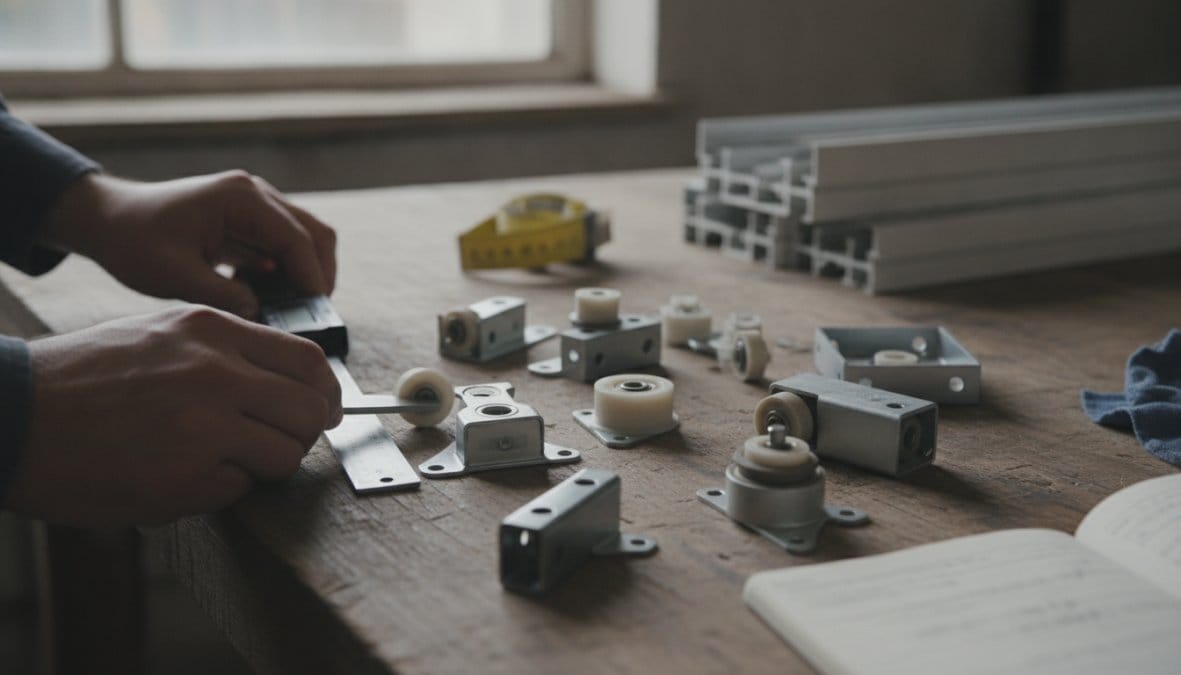
A metal measuring tape (at least 2 meters) gives you flexibility to measure both small roller dimensions and larger frame clearances. A digital caliper is your precision tool for measuring roller diameter and width, far more accurate than a ruler for small components. You’ll also need a ruler or straightedge, notepad, camera or smartphone, flathead screwdriver, and a clean cloth. A hammer or rubber mallet helps with safe sash removal.
Step 1: Identify Your Window Type and Roller Housing Style
Your window type determines which measurement approach to use and which replacement parts will fit. Not all aluminium windows use the same roller system.
Start by examining whether your rollers are mounted at the bottom of the sliding sash or at the top. Bottom-mounted rollers are most common in residential windows and sit in a track at the base of the sliding panel. Top-hung rollers hang from a track above the sash and are less common in residential settings.
Bottom-mounted vs. top-hung rollers
Bottom-mounted rollers sit in a horizontal track at the base of your sliding window and typically have a convex (rounded outward) wheel profile that grips the track. Top-hung rollers hang from an overhead track and often have a concave (rounded inward) wheel profile. The two systems use completely different mounting hardware and carriage assemblies, ordering a bottom-mounted roller for a top-hung window won’t work.
Visual identification guide for legacy and obsolete parts
Older windows, particularly those installed before 2000, often use roller designs no longer in production. Look for rollers with metal wheels instead of nylon, brass or steel ball bearings instead of modern sealed bearings, and housing assemblies that don’t match current Australian standards. If you find markings on the housing, photograph them clearly, these stamps often identify the original manufacturer and can help trace the exact part number.
Step 2: How to Remove Sliding Window Rollers Safely
Removing the window sash gives you full access to the rollers for accurate measurement. Start by opening the window fully and examining how the sash sits in the frame. Look for any visible fasteners, clips, or locking mechanisms that secure the sash in place.
Removing the sash and accessing the carriage assembly
To remove the sash safely, lift it slightly while tilting the bottom outward. This motion disengages the rollers from the track and allows the sash to come free. Stand on one side of the window and place your hands on either side of the sash, roughly in the middle. Lift gently while tilting the bottom edge away from you. Once the sash is out, lay it on a flat surface with padding underneath to protect the frame. Never rest it on the rollers themselves.
Now you can see the carriage assembly clearly. This is the metal housing that holds the roller wheel and connects to the sash. Examine how the roller is mounted, some are held by a single bolt, others by two bolts or clips. Take a photo of this assembly before disassembly.
Troubleshooting stuck vs. broken rollers
A stuck roller usually moves with resistance but does move when you apply moderate pressure. A broken roller won’t turn at all, or the wheel is visibly cracked or flat-spotted. To test, manually try to spin the roller wheel with your finger. If it rotates freely, it’s likely stuck and needs cleaning. If it won’t turn at all or makes grinding sounds, it’s probably broken.
Step 3: Measure Roller Diameter and Width Accurately
Roller diameter and width are the two critical measurements for ordering replacements. Diameter is the distance across the roller wheel from edge to edge and determines whether the roller will fit in your track. Most residential aluminium window rollers have diameters between 19mm and 25mm. Width is the measurement along the length of the roller wheel and determines how well the roller contacts the track.
Using caliper measurement for precision
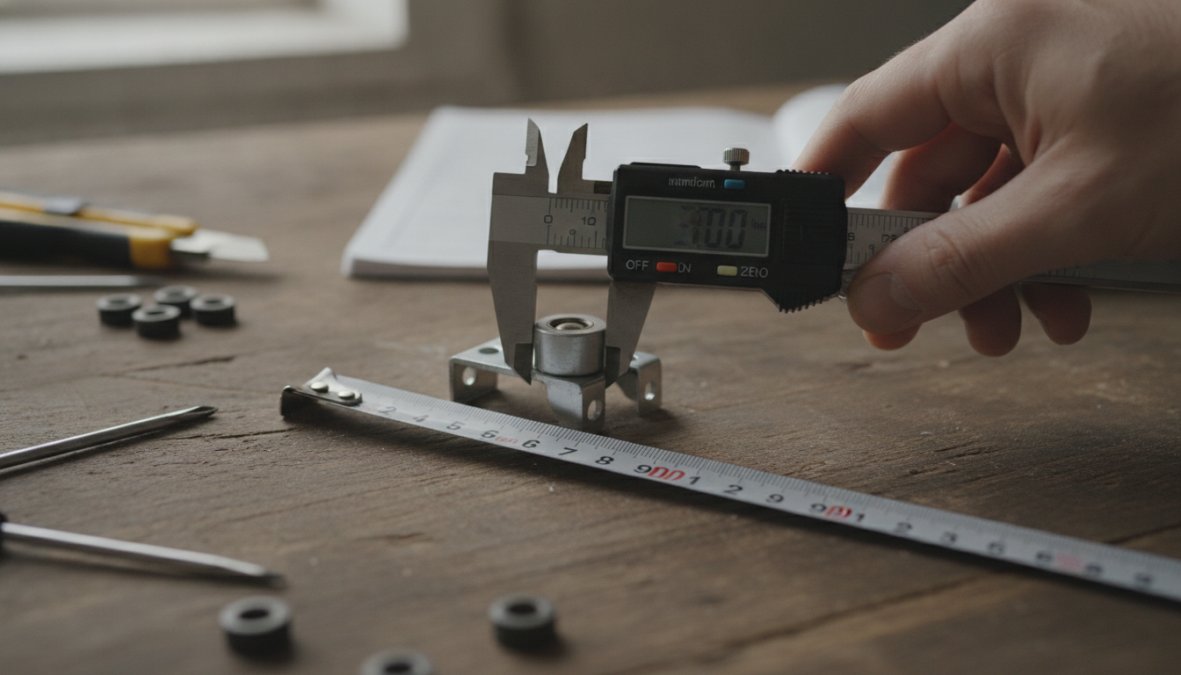
A digital caliper is the only tool that gives you the accuracy needed. Place the caliper jaws around the roller wheel perpendicular to the axis. Close the jaws gently until they touch the wheel surface on both sides. Read the measurement on the digital display. Measure in at least two places around the wheel’s circumference to account for any wear or deformation.
For width, position the caliper jaws parallel to the roller axis and measure from one side of the wheel to the other. Record these measurements in millimeters to two decimal places. For example: “Diameter: 21.5mm, Width: 12.0mm.”
Recording roller profile: convex vs. concave wheels
The wheel profile affects how the roller contacts the track. A convex wheel bulges outward in the middle and is most common in bottom-mounted rollers. A concave wheel curves inward and appears in some top-hung systems. To identify which you have, look at the wheel from the side. If the center is higher than the edges, it’s convex. If the center is lower, it’s concave.
Record this in your notes: “Convex wheel” or “Concave wheel.” When ordering replacements, specify the profile, using the wrong one won’t work, even if the diameter and width match.
Step 4: Check Housing, Mounting Holes, and Load Capacity
The carriage housing holds the roller and connects to the sash. Measuring this assembly ensures your replacement will bolt up correctly and support the window’s weight.
Start by examining the housing material. Most modern aluminium windows use aluminium or steel housings, but some older windows have brass or plastic components. Look at the overall shape and size of the housing, some are compact, others are larger and more robust.
Assessing carriage style and frame clearance
Measure the distance from the roller wheel center to the sash frame. This is your frame clearance and determines how much vertical space your replacement housing can occupy. Measure the length of the carriage assembly from front to back. Check whether the housing has adjustment screws, which allow fine-tuning of roller height to ensure smooth operation.
Verifying OEM specifications and hardware compatibility
Look for identification marks on the carriage housing, sash frame, or window frame itself. These might be embossed numbers, stamped manufacturer names, or adhesive labels. Photograph these marks clearly, they’re often the key to finding exact specifications. If you find a manufacturer name, note it. If you can’t find manufacturer information, measure everything carefully and bring these measurements to a supplier.
Step 5: Aluminium Window Roller Replacement and Material Compatibility
Choosing the right replacement roller material affects durability, noise levels, and long-term performance. Nylon wheels are the most common modern choice for residential windows, they’re quiet, durable, and resistant to corrosion. Steel ball bearing rollers offer higher load capacity and suit heavy commercial windows or high-traffic applications. Brass rollers are rare in modern windows but appear in some heritage or specialty applications.
Nylon wheel vs. steel ball bearing vs. brass options
For most Australian residential windows, nylon wheels are the best choice. They balance durability, cost, and performance effectively. Steel ball bearing rollers suit heavy windows or commercial applications where load capacity is critical. Brass rollers are specialty items chosen for aesthetic reasons or extreme corrosion resistance in coastal environments. Match your replacement material to your original where possible.
Ensuring track alignment and lubrication before installation
Before installing new rollers, clean the track thoroughly. Debris in the track creates friction and can damage new rollers quickly. Check track alignment by running your hand along the entire length. Apply a light coat of silicone-based lubricant to the track before installing new rollers. Install the new rollers according to the manufacturer’s instructions, ensuring they’re properly seated in the carriage assembly.
Common Mistakes to Avoid When Measuring Window Rollers
The most common mistake is measuring the wheel diameter at the narrowest point rather than the true diameter. Always measure at the widest point of the wheel. Another frequent error is confusing roller width with carriage width, measure the wheel width specifically, not the housing width.
Failing to check the wheel profile before ordering is another costly mistake. Not checking frame clearance causes installation problems. A replacement housing that’s taller than the original may bind against the sash frame. Finally, many people skip recording the material and profile details, then struggle to remember what they had when ordering. Write everything down: diameter, width, material, profile, and any manufacturer markings.
How to Measure Aluminium Window Rollers: Quick Reference Checklist
Use this checklist to ensure you’ve captured all the information needed for accurate replacement parts.
|
Measurement |
What to Record |
Why It Matters |
|---|---|---|
|
Roller diameter |
Measure in mm to 2 decimal places |
Determines track fit |
|
Roller width |
Measure in mm to 2 decimal places |
Affects track contact and load capacity |
|
Wheel profile |
Convex or concave |
Track compatibility |
|
Housing material |
Aluminium, steel, brass, or plastic |
Corrosion resistance and durability |
|
Mounting hole spacing |
Distance between bolt holes in mm |
Installation compatibility |
|
Frame clearance |
Distance from wheel center to sash frame |
Ensures housing fits without binding |
|
Roller material |
Nylon, steel, or brass |
Performance and maintenance needs |
|
Carriage depth |
Front-to-back measurement in mm |
Space availability in track |
|
Manufacturer marks |
Any stamps, labels, or embossed text |
Helps identify original specifications |
|
Adjustment features |
Presence of height-adjustment screws |
Fine-tuning capability |
Before ordering replacement parts, verify that your new rollers match every item on this checklist. This systematic approach prevents compatibility issues and ensures your repairs succeed on the first attempt.
Getting the wrong roller parts is frustrating and expensive. Slide Master Hardware specializes in identifying exact roller specifications from measurements and photos, even for discontinued or hard-to-identify windows. With same-day dispatch for in-stock parts and a 30-day change-of-mind return policy, we make it simple to get the right components for all major Australian window brands. Send us your measurements and photos, and our team will confirm the exact parts you need before you order.
Frequently Asked Questions
How do I know what size window roller I need?
Measure the roller diameter and width using a caliper or metal measuring tape while the roller is still mounted in the housing. Record the exact measurements in millimetres, then check the OEM specifications for your window brand. Note the roller profile (convex or concave), housing style, and mounting hole positions. If your window is an older model, take a photo of the entire carriage assembly and submit it to a hardware specialist like Slide Master Hardware for accurate identification.
What tools do I need to measure window rollers accurately?
Essential tools include a digital caliper (most accurate for diameter), a metal measuring tape, and a ruler or straight edge. You'll also need a screwdriver set to remove the sash and access the rollers, and possibly a flathead screwdriver to help extract stuck rollers. For detailed inspection of housing and mounting holes, a magnifying glass or smartphone camera zoom can help. Keep a notepad or phone notes app handy to record all measurements and observations.
Can I replace aluminium window rollers with different materials like nylon or steel?
Material compatibility depends on your window's track design and load capacity. Nylon wheels are lighter and quieter, suitable for standard residential windows. Steel ball bearing rollers offer greater durability for heavy commercial applications. Brass rollers provide corrosion resistance in coastal areas. Always verify that the replacement roller's load capacity matches or exceeds your window's weight requirements. Mixing incompatible materials can cause track misalignment and premature wear, so confirm OEM specifications before purchasing replacement parts.
How do I troubleshoot stuck vs. broken rollers before measuring?
A stuck roller typically moves with resistance but can be freed with lubrication and gentle pressure. Apply a silicone-based lubricant to the track and roller, then gently slide the window back and forth. A broken roller won't move at all or moves with grinding sounds and visible damage. Inspect the roller for cracks, flat spots, or detachment from the carriage. If stuck, clean the track thoroughly and relubricate before measuring. If broken, proceed with removal and measurement to order an exact replacement.
This article was written using GrandRanker